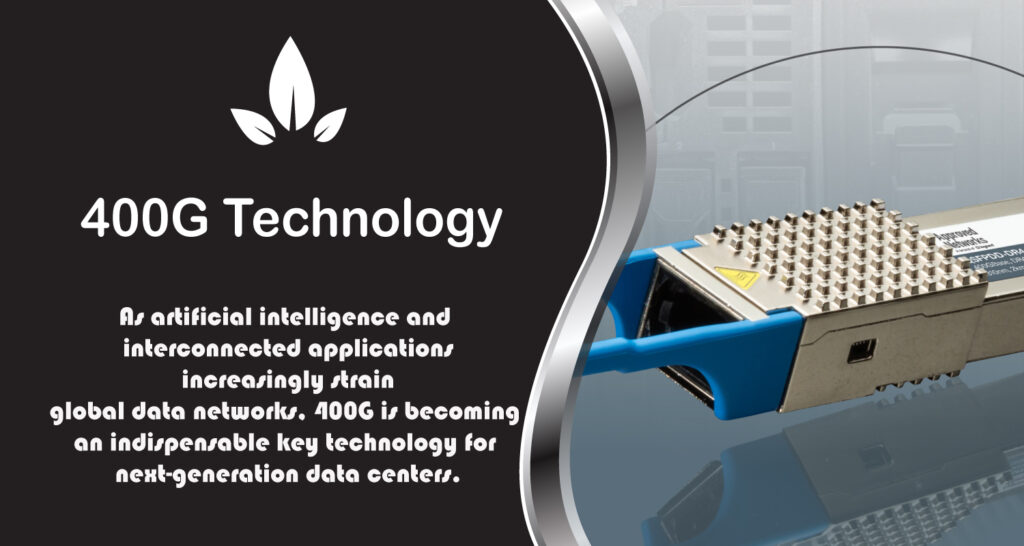

As artificial intelligence and interconnected applications increasingly strain global data networks, 400G is becoming an indispensable key technology for next-generation data centers.
Digital transformation is accelerating, placing increasingly higher demands on network infrastructure. Against this backdrop, 400G network technology has become a new benchmark for high-performance data centers and telecommunications networks. This technological leap is not merely about increased speed, but a comprehensive evolution of network architecture, crucial for managing the massive amounts of data from artificial intelligence, IoT devices, and real-time applications.
The Driving Forces Behind the 400G Revolution
Many factors are driving the adoption of 400G. According to Zayo, 400G wavelengths are already leading the way in meeting terabit-level bandwidth demands. While 100G remains the most widely used bandwidth specification in industries such as manufacturing, finance, and data centers, new data-intensive applications require even higher performance.
Artificial intelligence workloads, especially generative AI and large language models (LLM), are driving bandwidth demands at an unprecedented rate. Furthermore, the rise of Industry 4.0, along with the emergence of thousands of IoT sensors, high-resolution video formats, virtual reality, and advanced medical imaging technologies, is generating an ever-increasing volume of data streams. These applications require not only high throughput but also extremely low latency.
Technological Leaps Enable 400G
Several technological breakthroughs have enabled 400G. PAM4 (Four-Level Pulse Amplitude Modulation) modulation technology doubles the bit rate compared to traditional NRZ (Non-Return-to-Zero) coding, thus achieving higher data rates with the same number of channels.
Advances in pluggable optical devices have spurred the development of compact, high-performance transceivers, such as QSFP-DD (Quad-Channel Small Form Factor Pluggable Dual-Density) and OSFP (Eight-Channel Small Form Factor Pluggable). These products support eight 50G channels for 400G applications and are compatible with various fiber types.
In the fiber optic cabling field, structured cabling solutions based on MTP/MPO connectors are gaining increasing importance. These solutions enable seamless upgrades from 10G to 40G/100G and then to 400G through simple module replacement, and support port splitting, meaning one 400G port can be split into four independent 100G connections. 400G also play an important role in 800G migration. For instance, you can connect a pair of 400G FR4 modules to an 800G 2FR4 module via two OS2 single-mode fibers.
Practical Applications of 400G: Applications and Deployment
400G technology is being applied in various fields:
• Artificial Intelligence Clusters and Data Centers: Rapid data exchange between servers is crucial for training AI models. 400G provides the necessary bandwidth, eliminating bottlenecks in these high-performance computing environments.
• Finance: Banks and trading platforms require extremely low latency to support high-frequency trading systems while handling ever-increasing volumes of transaction data.
• Telecommunications Networks: Operators such as China Telecom and China Mobile have deployed 400G in their backbone networks to meet growing bandwidth demands and reserve capacity for future business development.
• Energy Industry: Industries outside of traditional IT, such as the energy sector, are also beginning to adopt 400G. For example, the State Grid Corporation of China has successfully tested a 355-kilometer-long 400G wavelength link to meet the needs of its communication network.
Future Outlook: Beyond 400G
The development of network technology has not stopped at 400G. The industry is actively developing 800G and 1.6T technologies. China Telecom has been the first in the world to successfully complete field testing of a 400G/800G hybrid ROADM network.
Meanwhile, new connectivity technologies are constantly emerging. For example, e-Tube is expected to become an alternative to copper cables and optical fibers. This technology utilizes dielectric polymer waveguides for high-frequency radio data transmission, and at transmission speeds of 1.6T and above, it is expected to offer advantages in efficiency, weight, and cost.
In the field of optical fiber, hollow-core fiber is expected to revolutionize communication technology. Compared to traditional optical fibers, hollow-core fiber reduces latency by approximately 30% because the speed of light in air is close to the speed of light in a vacuum, while nonlinear effects are also reduced by three orders of magnitude, thus significantly improving transmission capacity.
Conclusion
The transition to 400G is a crucial step in the development of digital infrastructure. While 100G will remain standard for many enterprises, 400G will become an indispensable foundation for data-intensive workloads in the age of artificial intelligence. Enterprises looking to ensure their networks are future-proof should incorporate the adoption of 400G technology into their strategic planning to meet growing demands and remain competitive.