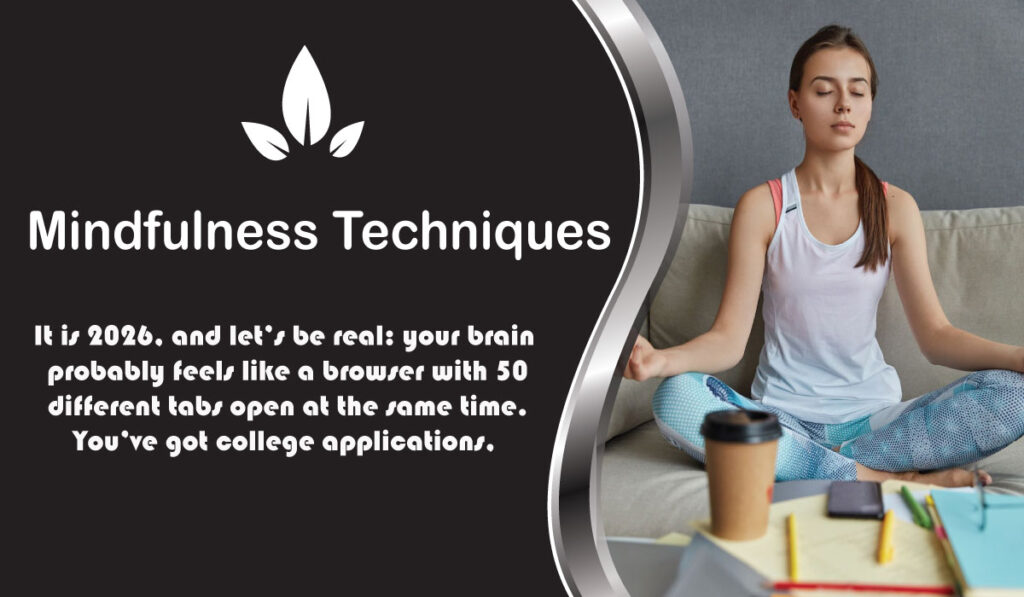

It is 2026, and let’s be real: your brain probably feels like a browser with 50 different tabs open at the same time. You’ve got college applications, that massive history project, your part-time job, and a social media feed that never sleeps. It’s easy to feel like you’re just running on a treadmill that keeps getting faster. This is why mindfulness is no longer just a “nice-to-have” hobby—it is a survival skill. Mindfulness isn’t about sitting on a mountain in silence; it’s about learning how to hit the “pause” button so you don’t burn out before graduation.
When you’re a senior in high school, the workload can feel like a literal mountain. Between AP classes and extracurriculars, there are days when you just need a break to breathe. Sometimes, the smartest way to protect your peace is to find a professional to do my online class so you can catch up on sleep, and take that weight off your shoulders. By letting experts handle some of the academic heavy lifting, you actually create the mental space you need to practice mindfulness and stay focused on what really matters.
1. The “5-4-3-2-1” Grounding Method
Have you ever been sitting in a test and suddenly your heart starts racing? Or maybe you’re staring at a blank Google Doc and your mind just goes totally blank? That is your “fight or flight” response kicking in. The 5-4-3-2-1 technique is a quick way to tell your brain, “Hey, we are safe. We are right here.”
How to do it:
- 5 things you can see: Look for small details, like a crack in the floor or the way the light hits your desk.
- 4 things you can feel: The fabric of your hoodie, the hard chair beneath you, or the cool air in the room.
- 3 things you can hear: The hum of the AC, a car driving by, or your own breathing.
- 2 things you can smell: Maybe your coffee or the scent of the library.
- 1 thing you can taste: Even if it’s just the mint you had earlier.
This forces your brain to switch from “panic mode” back into “observation mode.” It takes less than a minute but can totally change your vibe for the rest of the hour.
2. Box Breathing: The Navy SEAL Secret
If it’s good enough for elite soldiers, it’s definitely good enough for a math final. Box breathing is a simple way to hack your nervous system. When you’re stressed, your breathing gets shallow and fast. By force-slowing your breath, you send a signal to your brain to lower your cortisol (the stress hormone) levels.
The Steps:
- Inhale slowly for 4 seconds.
- Hold that breath for 4 seconds.
- Exhale slowly for 4 seconds.
- Hold your lungs empty for 4 seconds.
- Repeat 4 times.
Try doing this right before you walk into an interview or a big presentation. It’s like a “reset” button for your nervous system.
3. Mindful Scrolling (The Digital Detox)
In 2026, our phones are basically attached to our hands. We “doomscroll” without even realizing we’re doing it. You pick up your phone to check the time and suddenly you’ve spent 40 minutes on TikTok and you feel ten times more stressed than before.
Mindfulness in the digital age means being intentional. Before you open an app, ask yourself: “Why am I doing this?” Are you looking for a specific piece of info, or are you just bored? Try “Grey-scaling” your phone. When your screen is in black and white, it’s much less addictive. Taking a 10-minute “no-phone” walk every day can do more for your mental health than any “self-care” app ever will.
4. Managing the “Writing Block” with Awareness
We have all been there—it’s 11:00 PM and you have a 2,000-word essay due. The stress makes your muscles tight and your thoughts messy. This is the moment where many students ask for essay writing services at MyAssignmenthelp.com to help them structure their thoughts or handle a particularly tough topic. While getting expert help is a great way to lower your stress, mindfulness can help you get through the parts you do write yourself.
Next time you’re stuck, try a “Brain Dump.” Set a timer for three minutes and write down every single thought in your head, even if it’s “I hate this essay.” Once the junk is out of your head, your “real” creative thoughts have room to breathe. Mindfulness is about acknowledging the stress, accepting it, and then moving forward anyway.
5. The “Body Scan” for Better Sleep
Sleep is the ultimate study tool, but it’s hard to sleep when your brain is replaying every awkward thing you said in 2023. The Body Scan is a mindfulness technique designed to relax your physical body so your mind can follow.
Start at your toes. Tense them up as hard as you can for three seconds, then let go. Feel the tension leaving. Move up to your calves, then your thighs, your stomach, your hands, and all the way to your jaw. Most people don’t realize they are clenching their teeth until they consciously let go. By the time you get to your shoulders, you’ll usually be halfway to a deep sleep.
Why Mindfulness Actually Works for Grades
You might think, “I don’t have time for this,” but the truth is that mindfulness saves you time. When you are mindful, you are more focused.
- Less “Re-reading”: Have you ever read a page of a textbook and realized you didn’t process a single word? Mindfulness stops that.
- Faster Problem Solving: A calm brain finds patterns faster than a panicked one.
- Better Memory: Stress literally “blocks” your ability to retrieve memories. Mindfulness keeps the path clear.
Making it a Habit
The best part about mindfulness is that it’s free and you can do it anywhere—on the bus, in the cafeteria, or while you’re waiting for your computer to update. You don’t need to be perfect at it. Some days your brain will be a mess, and that’s okay. The goal isn’t to have zero thoughts; the goal is to notice your thoughts without letting them drive the car.
As you head into the final months of your senior year, remember that you are more than your GPA. Taking care of your mind is just as important as studying for your finals. Whether you are using a tool like Myassignmenthelp.com to manage a crazy schedule or using box breathing to get through a test, the key is to be kind to yourself.